Identity and Access Management (IAM) solutions safeguard systems, applications, and data by verifying user identities and granting access only to authorized individuals.
There are three critical first steps that organizations should follow before implementing an Identity and Access Management system:
-
Define desired IAM goals and strategy: Create a template for what the desired IAM implementation should look like.
-
Assess current security posture and IAM capabilities: Identify access control permissions and vulnerabilities in the current security posture.
-
Define target IAM access controls: Establish which IAM access controls should be implemented in the new IAM system.
Performing these steps clarifies your organization’s current IAM capabilities and defines new access controls for IAM implementation.
Step 1: Define Desired IAM Goals and Strategy
This step defines your desired IAM goals and governance strategy, including compliance requirements, access control methods, and which user identities and systems are in scope. It helps align IAM strategy with organizational priorities and requirements, including:
-
Documenting stakeholder requirements: Create a master list of access requirements for compliance stakeholders, including IT, enterprise security, auditors, regulatory groups, governmental regulations, and organizational management.
-
User identities and in-scope systems: Identify which users and systems fall under IAM protection. Be sure to account for shadow IT, especially unmanaged Software-as-a-Service (SaaS) applications.
-
Objectives and goals: Define measurable results and success metrics, such as reducing unauthorized access, simplifying logins, automating provisioning, or reducing ransomware risk.
-
Required access control methods: Determine required access methods such as single sign-on (SSO), multi-factor authentication (MFA), role-based access control (RBAC), or others.
This step provides a template for what your desired IAM implementation should look like and the requirements it must meet.
Step 2: Assess Current Security Posture and IAM Capabilities
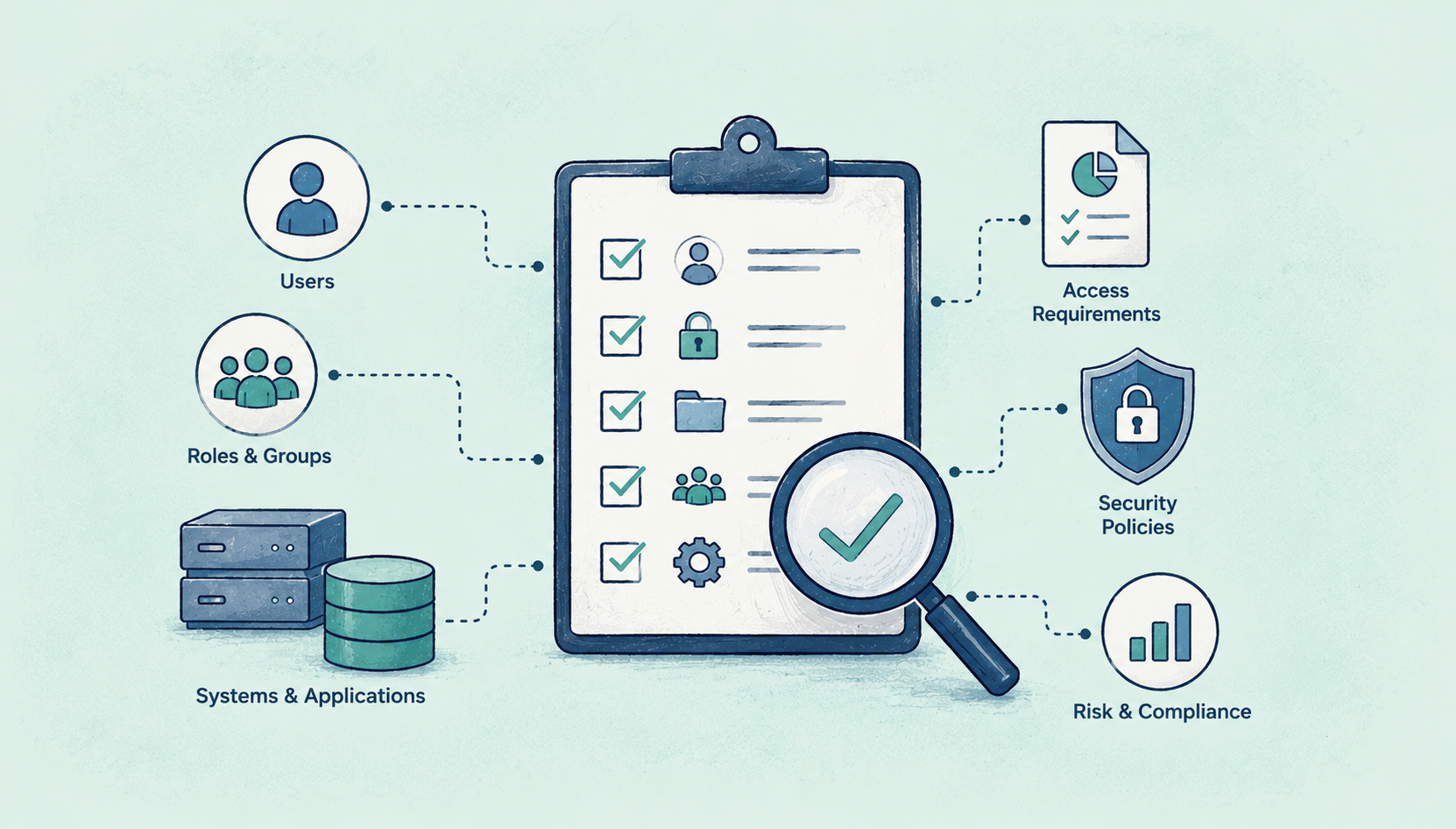
Perform a security posture assessment to document existing user identities and access controls for in-scope systems. This may involve enterprise security teams, third-party vendors, audit reports, or security software tools.
A security posture assessment may include:
-
Individual user access permissions: Permissions and access rights assigned to individual users.
-
User role and group permissions: Review access granted to system roles and user groups.
-
Data sensitivity levels: Identify systems and data requiring stricter controls, such as PII, financial data, or trade secrets.
-
Potential vulnerabilities and threats: Locate weak access controls that may increase exposure to cyberattacks.
Security posture assessments help identify security gaps and support the migration of access data into an IAM solution.
Step 3: Define Access Policies and Controls
Using the information gathered in earlier steps, define who can access which resources, what permissions they have, under what conditions access is allowed, and which access methods they can use.
Common IAM access control models include:
-
Automatic detection and importation of existing users and privileges: Useful for migrating current access controls.
-
Role-based access control (RBAC): Permissions are tied to predefined roles, and users inherit permissions based on role assignment.
-
Attribute-based access control (ABAC): Access decisions are based on user and resource attributes from systems such as HR platforms or Active Directory.
-
Principle of least privilege (PoLP): Users, roles, and groups receive only the minimum access required to perform their duties.
To improve compliance and audit readiness, consider aligning access policies with the NIST Digital Identity Guidelines (SP 800-63), including:
-
Identity Assurance Level (IAL): Identity proofing requirements.
-
Authentication Assurance Level (AAL): Authentication strength requirements.
-
Federation Assurance Level (FAL): Federation requirements when integrating identity or credential service providers.
Ready for Identity and Access Management Implementation
Completing these steps helps plan, define, and strategize your IAM implementation. The resulting clarity and structure set the foundation for a secure, efficient, and successful IAM program.